Evaluation-Kit SPE with PODL
NEWOrder Code 749951
Characteristics
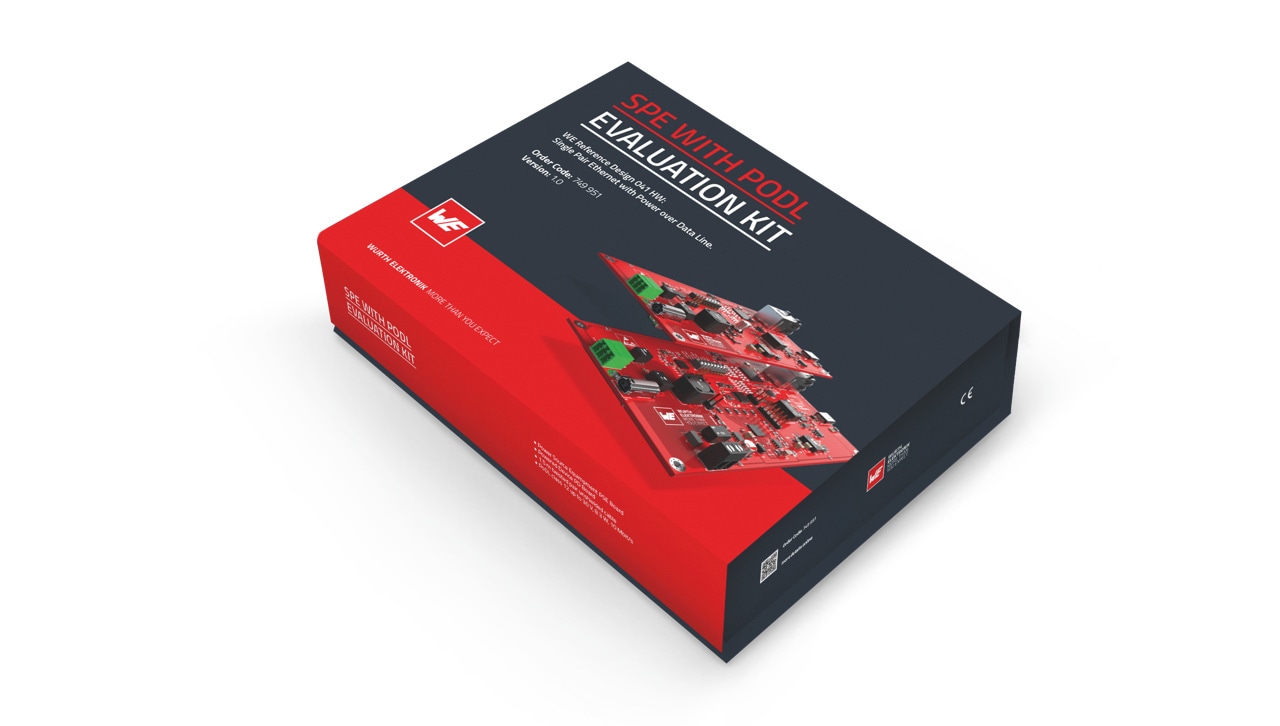
- Hardware implementation of Würth Elektronik Reference Design RD041, a fully functional Single Pair Ethernet with Power over Data Line system to evaluate, measure, and learn from before committing to a design.
- Includes a Power Source Equipment (PSE) board (749949) with a Powered Device (PD) board (749950), plus the WR-TBL connectors and 1.5 m of twisted copper wire needed to build the unshielded link between them. The link complies with IEEE 802.3cg (10BASE-T1L) and PoDL class 12, up to 30 V / 8.3 W. The PSE detects and classifies the PD via the SCCP protocol and supplies the correct power level; the PD operates at 24 V. The PSE accepts a 20–30 V external supply and is reverse-polarity, transient and overcurrent protected.
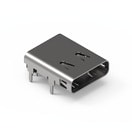
- Both boards include a USB 3.1 Type C port (data only, no power), a 10/100 Mbit/s Ethernet port and a 10 Mbit/s full-duplex SPE port. Data can be transferred between any two of these interfaces, on a single board or between boards over the single pair.
- Built for engineers who need a hands-on reference platform to validate PoDL classification, signal integrity, power delivery and data flow across USB, Ethernet and the single pair before designing a custom PSE or PD board.
- EU Declaration of conformity
Learn more about the SPE with PoDL Evaluation Kit
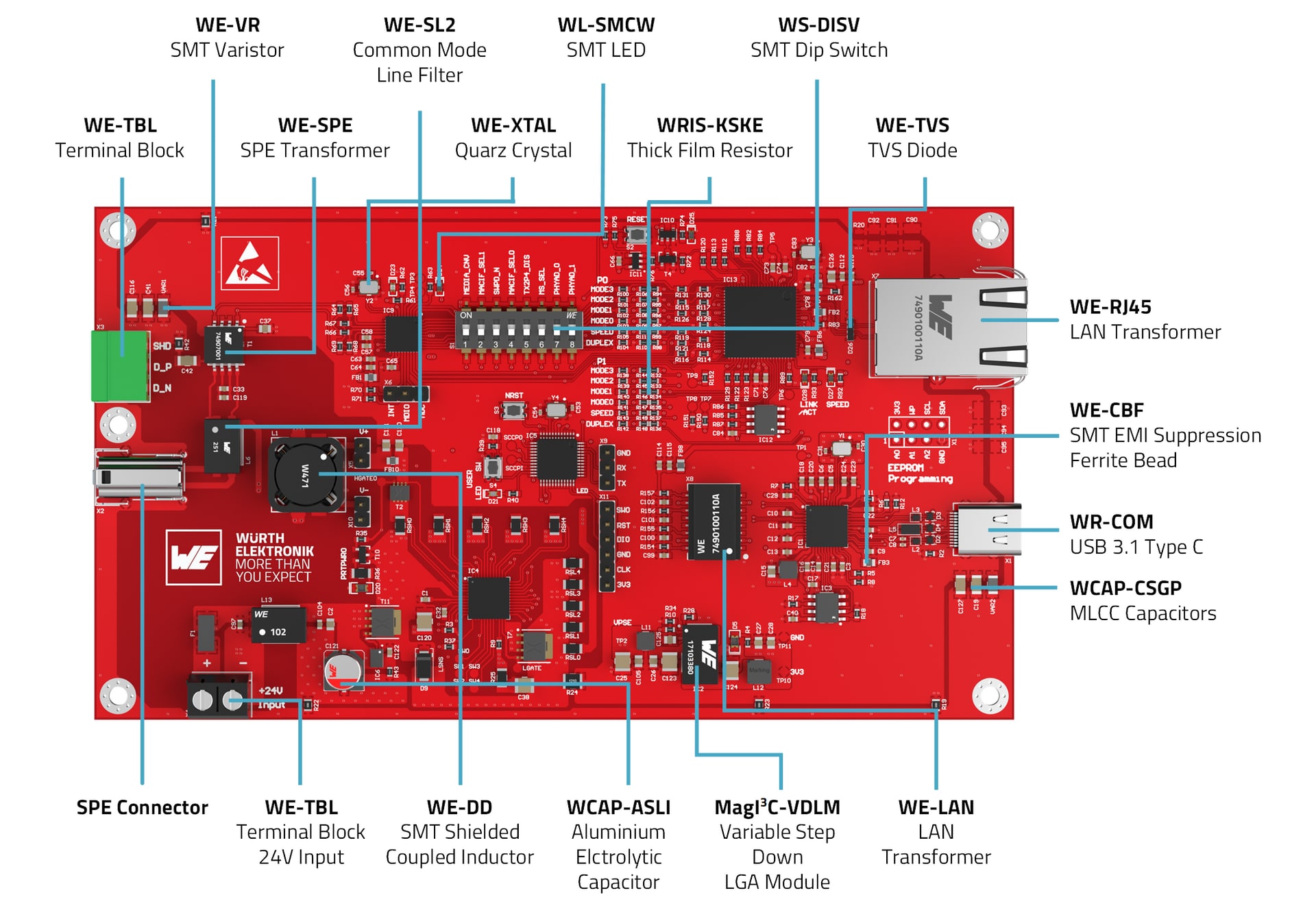
Power Source Equipment (PSE) Board
The PSE board supplies data and power over a single twisted pair. Connected to an external 20–30 V DC supply; the board detects and classifies the PD via the SCCP protocol and delivers the appropriate PoDL class 12 power level, up to 30 V / 8.3 W.
It also provides 10 Mbit/s SPE, 10/100 Mbit/s Ethernet and USB 3.1 Type-C data interfaces for flexible system evaluation.
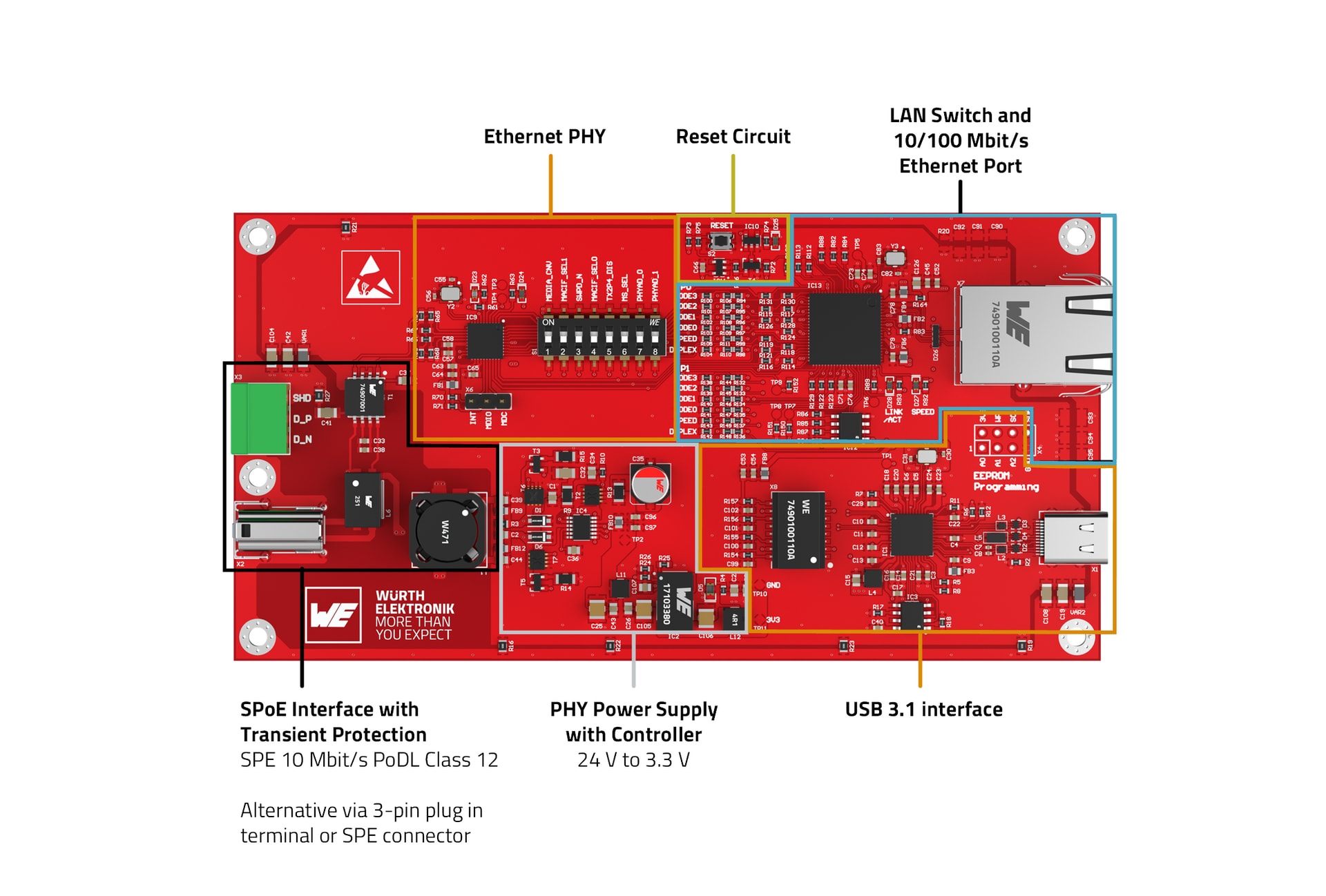
Powered Device (PD) Board
The PD board receives data and power from the PSE over the same twisted pair. Its 10 Mbit/s full-duplex SPE interface, 10/100 Mbit/s Ethernet port and USB 3.1 Type-C data interface enable data transfer between SPE, Ethernet and USB.
Use it to evaluate the powered-device side of the system, including PoDL power reception, data transfer and system behavior.
FAQ's
A Power Source Equipment (PSE) board (749949), a Powered Device (PD) board (749950), two WR-TBL terminal block connectors and 1.5 m of twisted copper wire to build the unshielded single pair link between the boards. The user manual is available online and also through the QR code printed in the packaging.
Single Pair Ethernet (SPE) is the data transmission over one twisted pair. Power over Data Lines (PoDL) adds power delivery over those same two wires.
SPoE — Single Pair Power over Ethernet — describes the combination, so SPE with PoDL and SPoE refer to the same concept.
The system operates to IEEE 802.3cg (10BASE-T1L) in PoDL class 12, providing up to 30 V / 8.3 W. The PSE detects and classifies the PD via the SCCP (Serial Communication Classification Protocol) and sources the appropriate power level.
Both boards have a USB 3.1 Type C port (data only, no power), a 10/100 Mbit/s Ethernet port and a 10 Mbit/s full-duplex SPE port. Data can be transferred between USB 3.1 and Ethernet, between USB 3.1 and SPE, and between SPE and Ethernet. The interfaces can be used in mixed or cross configurations and operated simultaneously, on one board and across boards.
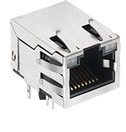
The SPE link is handled by an ADIN1100 10BASE-T1L PHY, and the Ethernet side by a LAN9355 switch/bridge with 10/100 Mbit/s port, both on the PSE and the PD board. The PSE board additionally carries an STM32G030C8T6 microcontroller, which manages PoDL classification and power switching. Around these, the boards integrate Würth Elektronik passive and active components, including the WE-SPE transformer designed specifically for this application, WE-LAN and WE-RJ45 LAN transformers, a MagI³C-VDLM variable step-down LGA module, WE-DD shielded coupled inductors, WCAP-ASLI and WCAP-CSGP capacitors, a WE-TVS diode, a WE-VS varistor and a WE-SL2 common mode line filter. The complete bill of materials is in Reference Design RD041.
An external 24 V supply connected to the PSE. The input accepts 20–30 V and draws less than 700 mA. The supply is not galvanically isolated — if your application requires isolation, it must be provided by the external 24 V supply.
The kit ships with 1.5 m of wire. For this evaluation kit we recommend a maximum length of 100 m between PSE and PD. IEEE 802.3cg class 12 itself specifies up to 1,000 m with AWG 18 cable.
The SPE link runs at 10 Mbit/s full duplex. The buffer between the Ethernet bridge and the SPE PHY only works correctly when the connected equipment is also set to 10 Mbit/s full duplex, so set Speed & Duplex manually in your PC's network adapter properties before the first test. Chapter 6 of the user manual walks through the steps.
Yes. Würth Elektronik declares CE conformity for this product. The hardware was tested for emissions to CISPR 32 Class B limits and meets the industrial immunity requirements of IEC 61000-6-2 using the CISPR 35 setup. Conducted and radiated emission results are in the user manual; the full analysis is documented in Application Note ANP141, "The SPoE Interface from an EMC Perspective".
Reference Design RD041, "Design of a Single Pair Ethernet System with Power over Data Lines (SPoE)", contains the complete design data and BOM, and is available free of charge.
No. The boards are evaluation hardware, intended for laboratory use by qualified personnel and not for resale or use in final customer applications. Read the Terms of Use for Evaluation Boards, Kits or Modules before you start.
Products of interest